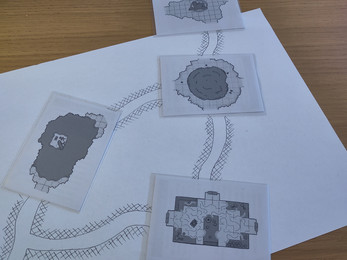
Lost in the shuffle is a free resource to generate random dungeons. It is clearly a small passion project. You have a deck of premade dungeon rooms from which you draw random rooms while exploring.
The rooms themselves are varied and look fun. They seem to be balanced around B/X D&D levels 3 to 5. Many have small twists and things to discover. This makes the rooms worthy of investigation.
Some of these descriptions have a random d4 table. At the moment of writing there are only 24 cards but he wants to extend this to 52. (1 room per week).
The cards are double-sided. One side shows the layout of the room while the other has some description. It can be printed using a home printer and either glued together or held together with mtg sleeves.
I like that the cards have a simple format. It is the kind of format that I can extend by myself, should I need to. The rooms have a drawing on one side and text on the other. This adds some visuals that you can also show your players.
So why would you use this compared to say a traditional dungeon?
It scales better
If you throw in a well-xandered dungeon, your players can go anywhere. Most content will likely be unused. When players only explore a quarter of a dungeon and then leave it is a waste of prep. It is frustrating for the GM.
Using a deck of cards solves this. You are more likely to actually use the content you prepare. If you explore 5 rooms, the GM has spend 5 rooms from his deck. A deck of 24 cards will now be only 19. Only when the deck becomes small, you’ll get problems.
It is not an infinite dungeon
My first thought when I saw this product was, cool, I can use this for solo games. Some cards have secrets on them. There is no reason to ever go past the trap in room #12. It leads to a dead end without rewards. This makes them ill-suited for solo gaming, but you also shouldn’t reuse these cards in normal games.
Not having reusable cards limits it a bit but also frees up design. Any encounter will be fresh. Players haven’t seen it before and will not see it again. That helps a lot when making a dungeon generator.
You’ll run out of encounters sooner or later. If every session burns a couple of cards, it is inevitable. To counter that, you need to write custom rooms to add. Don’t worry about this until the pile of unused cards gets small.
One way to make new content is to scavenge old RPG books. Take any adventure you have lying around and look for fun stuff. Then make a card for each one of them.
It lacks connectivity
No product is perfect. If you pull out rooms from a deck and only use that, they will feel random. Choices matter less and exploration becomes less interesting.
For example, your players arrive at a T-junction. They can either go left or right. Both options will lead to drawing a card from the pile. Then it doesn’t matter at all what direction they choose.
This is an easy problem to get in random dungeons. However, if you use some tricks, you can reduce this. It will not be perfect, but it will be better.
We will add connectivity and choice with a couple of techniques. Trick 1 adds extra content. Trick 2 makes by having quest discoveries. Trick 3 helps by listening to the players.
Trick 1 – Write rooms in pairs
If we write rooms in pairs, we can regain some connectivity. Whenever you draw a room, you’ll add another room related to that one.
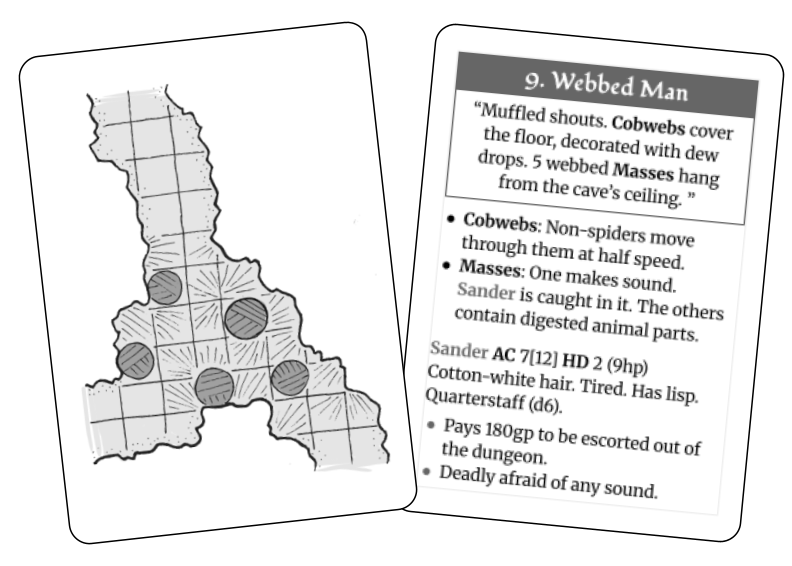
For example take room 9, the Webbed Man.
Based on this description, what can you add?
The spider webs aren’t explained but this could very well be a big spider. Add a room to the side.
There is a side-quest to escort sander back. You can make this more challenging by adding a room in front with some sounds. Maybe a lot of webs and creaky floor-boards.
Spiders can also climb vertically. Add a room with a treasure hidden significantly higher. Add a small spider swarm for added difficulty.
You now have four rooms where you used to have one. This is more than big enough.
While not every room will be as easy to extend, it is good to try it, where possible. This changes the rooms into small room clusters connecting stuff. Players don’t know where the boundary between one room cluster and the next is.
If this is hard on the fly, stop. Your time at the table can be better spend to make the story continue. The job of a GM is hard enough as is.
There are only a small number of cards. You can think of some ideas beforehand. Just draw each card and think for a few minutes about what this card implies. You don’t even have to write anything down.
Trick 2 – Have a bare-bones quest
Your players probably went in the dungeon with a goal. They may want to kill an evil villain or rescue the town’s children. Whatever it is, you can reinforce this quest within the dungeon.
When prepping, write an ending. This should be a custom room (or several ones) based on the quest. Then list a couple of generic hints you can drop during the game. Try to sprinkle those hints while players explore the dungeon.
A simple exploration mechanic can help keep things fair. For example, the players need to collect 5 points before reaching the final room. Each room card discovered and each clue followed gives one point.
This can lead to railroading but it doesn’t have to be. You can give out clues when players search. The search may result in a random encounter check. If you have several quests, you can give players a choice where to go.
Trick 3 – Trust your gut
A bare-bones quest and writing rooms in pairs help a lot. However, they don’t do everything. Sometimes you notice an obvious connection or feel like something is missing. Act on that instinct.
If something feels missing, add it. Use these cards as a fallback to other ideas. If you want to change something to make it fit better, that is also fine. These cards aren’t holy.
My plan
I like this product and want to experiment with it. However, I am not running B/X D&D and my pathfinder 2e campaign is level 10. I don’t think this will fit.
I might do it with a solo adventure. That said, I do see problems with that too. I already know several rooms and one of the design principles is that you don’t know it. (The same reason you don’t shuffle the cards back in the deck).
For now I save this gem. I might never use it as is but I do like the idea.
Leave a Reply